Live Boxing Betting: How In-Play Markets Work Round by Round
 Available in US
The bell rings, two fighters touch gloves, and the first jab snaps out. In the time it takes for that jab to land, the moneyline has already moved. Welcome to live boxing betting, where the market reacts to every punch, every clinch, every shift in momentum, and your ability to process what you’re seeing faster than the algorithm determines whether you find value or chase it.
In-play wagering has become the dominant force in online sports betting. Precedence Research reports that live bets accounted for 62.35% of all online sports betting revenue in 2025, growing at 13.62% CAGR through 2031. Boxing is uniquely suited to this format. Unlike football or tennis, where play is continuous and pauses are unpredictable, boxing has built-in breaks of sixty seconds between rounds that create natural decision windows. Each round is a discrete unit of action followed by a structured opportunity to assess, adjust, and act.
I’ve been betting boxing in-play since the market matured enough to offer meaningful round-by-round pricing. The experience is different from pre-fight betting in every way that matters: faster decisions, higher emotional intensity, and a constant temptation to react rather than analyse. This guide covers what you need to know to bet live boxing effectively, from the markets available to the discipline required to avoid the traps that catch most punters mid-fight. Learn more about bet on boxing on our main page.
Table of Contents
- How In-Play Boxing Betting Differs from Pre-Fight Markets
- Markets Available During a Live Boxing Bout
- How Odds Shift Round by Round
- Reading Fight Momentum for In-Play Decisions
- Latency, Cash Out, and Execution Speed
- Watching the Fight While Betting: Streaming Integration
- Emotional Discipline in Live Boxing Wagering
- Frequently Asked Questions
How In-Play Boxing Betting Differs from Pre-Fight Markets
Pre-fight betting gives you days or weeks to analyse a matchup. You study film, check records, assess training camp reports, compare odds across operators, and place your bet with a clear head. Live betting gives you roughly 45 usable seconds between rounds. The analytical process that normally takes hours gets compressed into a window shorter than a television commercial break.
That compression changes everything. Pre-fight, your edge comes from deeper research and better probability estimation. In-play, your edge comes from faster and more accurate assessment of what’s actually happening in the ring. These are different skills. A punter who excels at pre-fight analysis may struggle with in-play, and vice versa. The fighters who profile well on paper sometimes look completely different once the first bell rings, and the live market adjusts to the reality in the ring, not the expectation on the spreadsheet.
The bookmaker’s in-play pricing model is also fundamentally different. Pre-fight odds are set by traders using historical data, public information, and the weight of money from early bettors. In-play odds are driven by algorithms that update continuously based on fight events: knockdowns, cuts, referee warnings, round-by-round scoring assessments. These algorithms are fast, but they’re not perfect. They can overreact to a single dramatic moment, such as a flash knockdown in round one, and create temporary mispricings that a knowledgeable observer can exploit.
The biggest structural difference is information asymmetry. Pre-fight, every bettor has access to the same public information. In-play, punters watching a high-quality live stream have a meaningful advantage over those relying on text commentary or social media updates. If you can see the fight happening in real time and the algorithm is updating based on data with even a few seconds of delay, you’re operating with better information than the machine. That edge is small and fleeting, but it exists.
Markets Available During a Live Boxing Bout
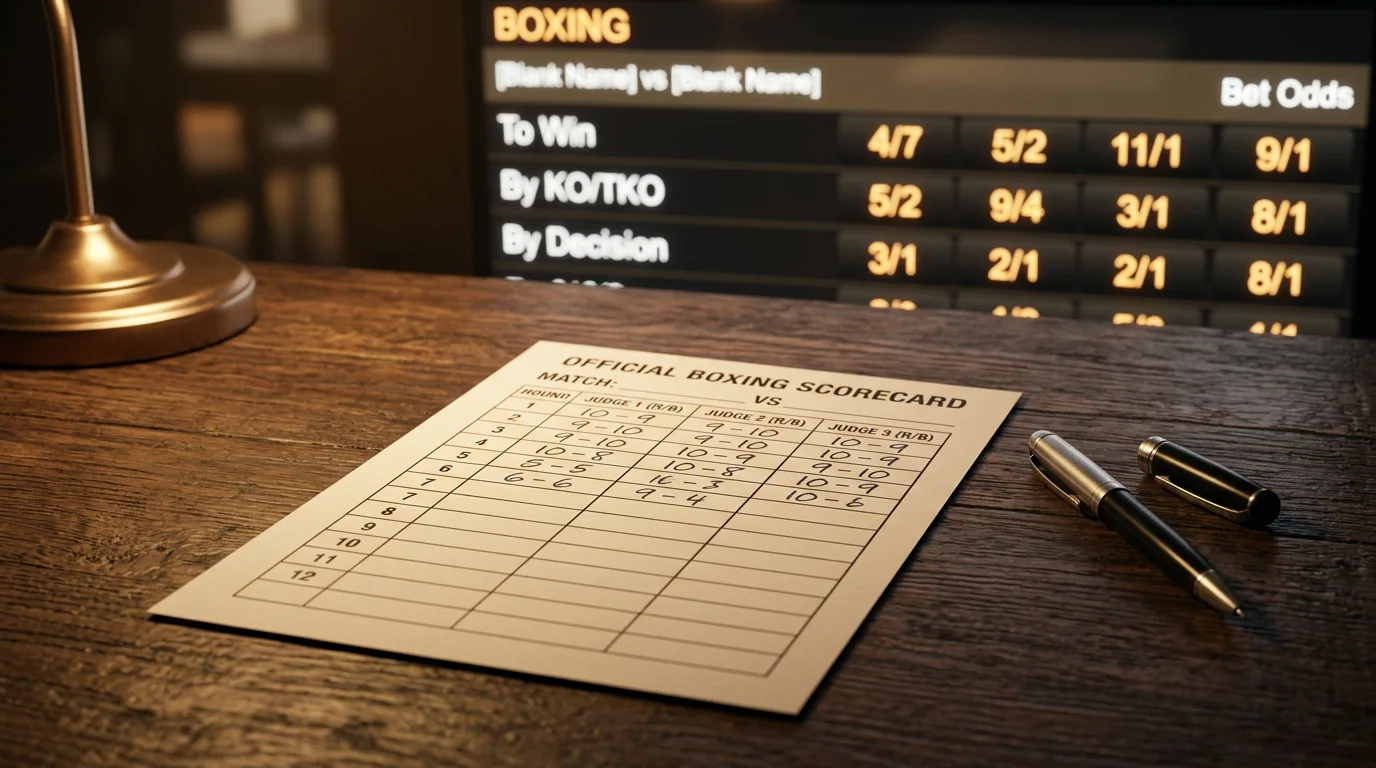
Not every market that’s available pre-fight remains open once the action starts. The moneyline, the market for picking who wins the fight, stays live throughout, with odds updating between rounds and sometimes during rounds depending on the operator. Next round betting is the signature in-play market: before each round begins, you can bet on whether that specific round will produce a stoppage and which fighter will be stopped. This market opens during the rest period and closes at the bell.
Over/under rounds adjusts dynamically as the fight progresses. If the pre-fight line was set at 8.5 rounds and the fight reaches round six without a stoppage, the new in-play line might shift to 10.5 or even “will the fight go the distance.” The pricing reflects updated information: five completed rounds without a knockdown suggest a more durable contest than the pre-fight assessment anticipated.
Method of victory remains available on most operators during live play, though the odds shift dramatically based on what’s happening. A fighter who lands a huge shot in round three will see his KO/TKO price collapse and the decision price stretch. Conversely, a fighter who’s clearly outboxing his opponent but showing no knockout power will see the decision price shorten round by round.
Knockdown markets and props tend to have limited in-play availability, as most operators price them pre-fight only or close them after the first few rounds. The full guide to boxing betting markets covers the pre-fight versions of each market in detail, but it’s worth noting here that in-play coverage is always thinner than pre-fight coverage. Plan your live betting around the markets you know will be available, rather than hoping the market you want opens mid-fight.
How Odds Shift Round by Round
Watching odds move round by round during a live fight is one of the most instructive exercises in boxing betting. It shows you exactly how the market digests information in real time, and where the algorithm’s assessment diverges from what your eyes are telling you.
After round one, a fighter who landed a clean right hand and visibly hurt his opponent might see his moneyline shorten from 2.50 to 1.90. That movement reflects the knockdown or near-knockdown event, but it may overweight a single moment in a twelve-round fight. If you know from tape study that the hurt fighter has historically recovered well from early adversity and tends to improve in the later rounds, the 1.90 price on his opponent might actually represent worse value than the pre-fight 2.50, not better.
The pattern of overreaction is most pronounced after knockdowns. A knockdown in round two of a scheduled twelve-round fight shifts the odds dramatically — often by 30-50% on the moneyline — because the algorithm weights it as a strong signal that the knocked-down fighter is vulnerable. Sometimes that signal is accurate. But knockdowns from flash punches, where the fighter rises immediately and shows no lasting damage, are different from knockdowns caused by sustained punishment, and the algorithm doesn’t always distinguish between them. The human who watched the fight does.
Conversely, odds can fail to move enough after subtle but significant shifts. A fighter who starts the fight boxing beautifully from the outside but gradually gets pushed onto the back foot by round five might not trigger dramatic odds movement because there’s no single event for the algorithm to react to. But the trajectory of the fight has changed, and the live price hasn’t caught up. These slow-moving mispricings are harder to identify but often represent better value than the dramatic post-knockdown swings.
Reading Fight Momentum for In-Play Decisions
Momentum in boxing isn’t a statistic — it’s a feeling. And betting on feelings is usually a terrible idea. But fight momentum is observable if you know what to look for, and translating those observations into in-play decisions is the core skill of live boxing wagering.
Ring position is the first indicator. A fighter who starts the bout controlling the centre of the ring but gradually retreats to the ropes is losing territorial control. That shift often precedes a shift in scoring, because judges reward the fighter who dictates where the action takes place. Punch volume is the second: a fighter throwing fewer punches per round as the bout wears on is either tiring, becoming cautious, or losing confidence. None of those are positive signals.
Body language between rounds is underrated. Watch the corners. A fighter who sits down heavily on his stool, breathes with his mouth open, and needs the cornerman to physically lift his arms for the water bottle is in a different physical state from one who stands, bounces, and engages actively with his trainer’s instructions. Television coverage often cuts away to replays during the rest period, but if you’re watching on a stream that shows the corners, that sixty seconds of footage is some of the most valuable visual data available.
The challenge is distinguishing genuine momentum shifts from noise. A fighter can lose three rounds in a row and still be exactly where his corner wants him — some fighters are slow starters by design, weathering early pressure before taking over in the middle rounds. Betting against that fighter in round four because he “lost momentum” is betting against his game plan, not against his ability. Knowing a fighter’s historical pattern — does he start fast or slow, does he tire or improve, does he respond to adversity or fold — is what separates informed momentum reads from emotional ones.
Latency, Cash Out, and Execution Speed
Mobile devices handle 78% of all online bets globally, per Precedence Research. You may also find Mobile Boxing Betting: How Smartphones Reshaped Fight-Night Wagering interesting. On fight night, that proportion is higher still. You’re watching the fight on one screen and betting on your phone, and the speed at which your phone processes the bet matters more than you might think.
Latency in live boxing betting has two components. Platform latency is how quickly the bookmaker’s app or website reflects updated odds after a round ends. Stream latency is how far behind the live action your video feed sits. If your stream is running ten seconds behind the real fight and the operator’s odds update in real time, you’re seeing odds that reflect events you haven’t witnessed yet. That’s not an edge but a trap, because you’ll place bets based on information that’s already stale.
Cash out speed is the other critical latency factor. If you have a pre-fight bet that you want to settle mid-fight, the cash out value changes with every round. A slow-loading cash out screen or a processing delay of even a few seconds can mean the difference between locking in a profit and watching the value evaporate as the odds shift. I’ve had cash out offers change by 20% while the app was processing my request. It doesn’t happen often, but when it does, the frustration is significant.
The practical solution is straightforward: use the fastest available connection, close unnecessary apps, and test your betting app’s live performance before staking serious money in-play. If the app consistently lags during peak fight-night traffic, you’re better off limiting your in-play activity to the rest periods between rounds, when the odds are stable and the processing window is wider.
Watching the Fight While Betting: Streaming Integration
The boxing audience has changed fundamentally. Fury vs Makhmudov on Netflix in April 2026 drew an average minute audience of 5 million UK viewers, according to Netflix and Advanced Television. Jake Paul vs Anthony Joshua on Netflix in December 2025 reached 33 million viewers globally. These aren’t pay-per-view numbers that require a 25-pound commitment. They’re free-to-stream audiences arriving with zero financial barrier.
Olly Campbell, a boxing journalist at BoxingNews24, described the April viewership as a “massive wake-up call for the boxing industry,” noting that when the barrier drops, the crowd grows. For live betting, that expanded audience has a direct consequence: more viewers means more first-time bettors, more first-time bettors means more uninformed money in the market, and more uninformed money means more opportunities for sharp punters who are actually watching the fight and processing what they see.
Streaming integration — watching the fight through the bookmaker’s own platform while betting — is offered by some UK operators, though the quality varies. The advantage of an integrated stream is that it’s synchronised with the odds feed, eliminating the stream-delay problem that plagues punters watching on a separate platform. The disadvantage is that bookmaker streams are typically lower quality than dedicated broadcast feeds, which can make it harder to read the subtle visual cues that inform good in-play decisions.
My preference is to watch the primary broadcast — whether that’s Netflix, DAZN, or a traditional pay-per-view service — on the best screen available, and bet on my phone using the bookmaker’s app. The slight stream delay is a manageable trade-off for the superior visual quality, as long as I’m aware of the delay and don’t react to odds movements that are ahead of what I’m seeing.
The shift from pay-per-view to free streaming has also changed the composition of the in-play betting market itself. PPV audiences were self-selecting — people who paid 25 pounds to watch a fight were disproportionately knowledgeable fans. Free streaming audiences are far broader, which brings in a wave of casual bettors who are placing their first ever in-play wager because the fight is already on their screen and the betting app is one tap away. For experienced live bettors, that influx of uninformed money creates pricing inefficiencies that simply didn’t exist in the PPV era.
Emotional Discipline in Live Boxing Wagering
I lost more money in my first six months of live boxing betting than in my first two years of pre-fight wagering. The reason wasn’t analytical — I was reading fights reasonably well. The reason was emotional. Live betting removes the cooling-off period that pre-fight wagering naturally provides. You see something exciting happen, the odds shift, and the temptation to act immediately is overwhelming. That impulse is the enemy.
The Gambling Commission reports that approximately 2.7% of UK adults — around 1.4 million people — are classified as problem gamblers. Live betting, with its speed, its emotional intensity, and its low friction, is a format that amplifies risk for vulnerable individuals. Even for disciplined bettors, the fight-night atmosphere can erode good habits. The alcohol, the social pressure, the adrenaline — all of it pushes you towards impulsive decisions.
My rules for in-play discipline are non-negotiable. First, I set a session limit before the card starts — a maximum number of bets and a maximum total stake for the evening. Second, I never chase a losing pre-fight bet with an in-play bet designed to recover the loss. Third, I only bet in-play on fights I’ve analysed beforehand; the impulse to bet a fight I didn’t study simply because it’s happening in front of me is a trap I’ve fallen into enough times to recognise it instantly. Fourth, I take a breath between rounds. The sixty-second break is long enough to assess, but short enough to pressure you into rushing. Use the first thirty seconds to watch the corners and process the round. Use the last thirty to check the odds and decide. If the decision isn’t clear, don’t bet. There will be another round.
Live boxing betting rewards the patient and punishes the reactive. The punters who profit in-play are the ones who watch more rounds than they bet on, who let mispricings come to them rather than hunting for action, and who treat each rest period as a decision point rather than a deadline. That patience is harder to maintain than any analytical framework, and it’s the one factor that separates profitable live bettors from the rest.
Frequently Asked Questions
Which boxing markets stay open during in-play betting?
The moneyline (outright winner) remains available throughout the fight on most UK operators, with odds updating between rounds. Next round betting opens during rest periods and closes when the bell rings. Over/under rounds adjusts dynamically as the fight progresses. Method of victory is available on many platforms with shifting odds. Knockdown and prop markets typically have limited or no in-play availability.
How quickly do in-play boxing odds change between rounds?
Most operators update live boxing odds within 10 to 20 seconds of the round ending. The odds then remain relatively stable for the duration of the rest period — roughly 40 to 50 seconds of usable betting time. After a dramatic event like a knockdown, odds may update faster and more aggressively. The exact speed depends on the operator’s trading algorithms and the significance of what happened in the round.
Can I cash out a boxing bet mid-fight?
Many UK operators offer cash out on boxing bets during the fight, though availability varies by market and operator. Moneyline bets are most commonly eligible for in-play cash out. Round betting and method of victory may have restricted cash out options. The cash out value updates between rounds based on the current state of the fight, so the amount offered can change significantly from one round to the next.
Does streaming delay affect live boxing betting decisions?
Yes. If your video stream is running behind the live action by even a few seconds, you may see odds that reflect events you haven’t witnessed yet. This can lead to poorly informed bets or missed opportunities. Using the bookmaker’s integrated stream, where available, minimises this issue. If watching on a separate platform, account for the delay and avoid reacting to odds movements that seem disconnected from what you’re seeing on screen.
Created by the ”bet on Boxing” editorial team.