
The Venue Effect in Boxing Betting: How Location and Promotion Shape Odds
 Available in US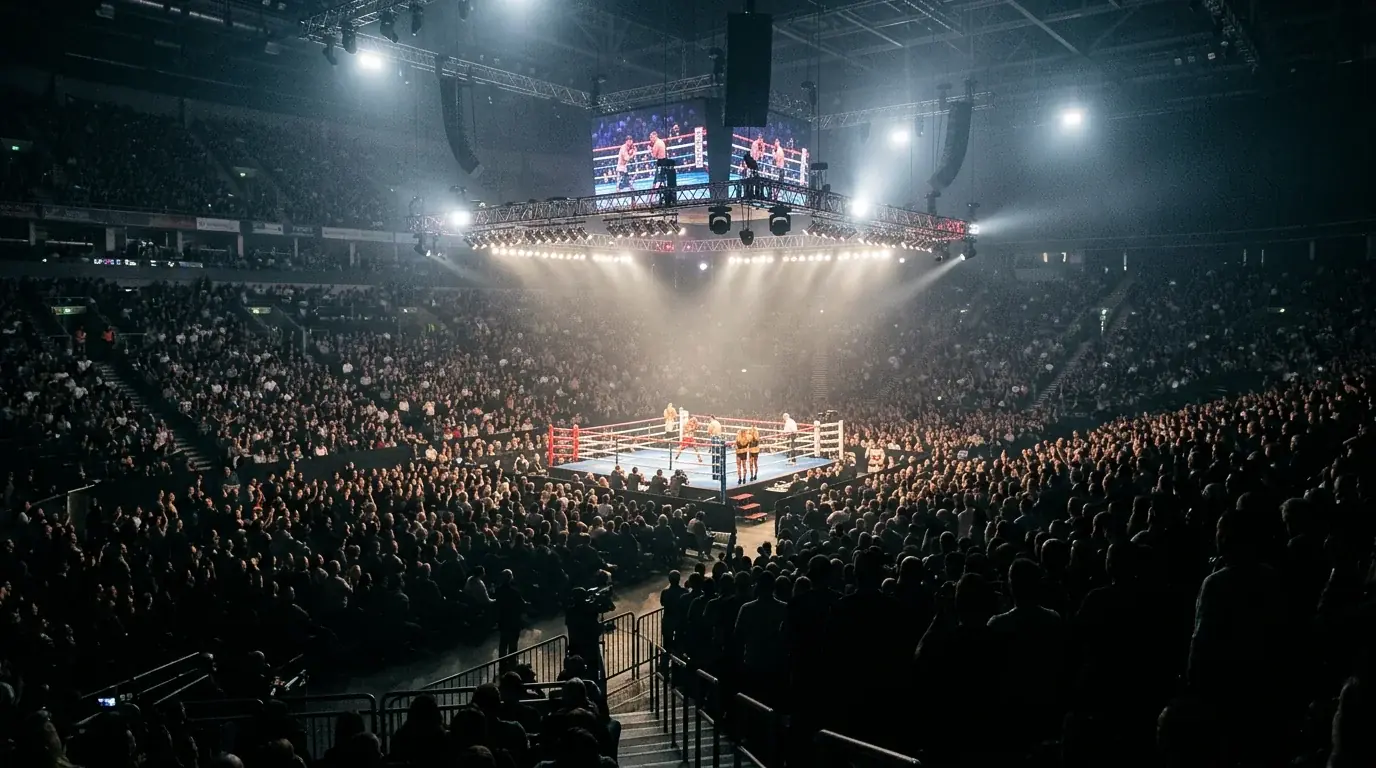
I once watched a heavyweight fight at the O2 Arena in London where a hometown favourite fought a foreign challenger to a draw on what looked, from where I was sitting, like a fairly clear loss. The official scorecards came back two-one for the favourite. I had backed the challenger at decimal 3.50, and the bet went down on what I am still convinced was a venue-influenced decision. That night, sitting in the back of a black cab home, I added a new variable to every fight-night spreadsheet I have used since: who is fighting where, in front of whose crowd, under whose promotion. The data has been more interesting than I expected.
Boxing has always been a sport where venue and atmosphere matter. The vocal crowd at a UK title fight, the empty atmosphere of a Las Vegas non-headliner, the cultural significance of a homecoming bout — all of these affect not just the experience of watching the fight but the actual outcomes the markets price into the moneyline. The Fury versus Makhmudov bout in April 2026 at Tottenham Hotspur Stadium drew an attendance of around 64,500 spectators, and the audience scale itself is a meaningful input to how that bout was contested.
This guide walks through the mechanics of home-crowd influence on judging panels, the leverage that promoters exert over matchmaking and venue selection, the patterns visible in neutral-venue fights, and the dynamics specific to mega-event stadium bouts that have come to dominate the modern UK boxing calendar. Discover everything about bet on boxing here.
Does a Home Crowd Influence Boxing Judges?
The short answer is yes, and the magnitude is meaningful for betting purposes. The longer answer is that the effect is uneven, asymmetric, and depends heavily on the specific venue, sanctioning body, and panel composition. Punters who incorporate venue effect into their analytical work systematically can find consistent value at the margins of close decisions.
The mechanism is partly psychological and partly procedural. Boxing judges score rounds in real time during the bout, with limited opportunity to revise earlier rounds even when later evidence suggests they may have got the early scoring wrong. Crowd reaction provides ambient signal that influences the judge’s perception of round outcomes, particularly in close rounds where the fighter who landed the more “telling” punch is genuinely ambiguous. A roar of approval after a punch that lands cleanly registers differently in a judge’s perception than the same punch in a quiet venue.
The aggregate evidence supports the existence of a measurable home-corner effect. Across the modern professional era, fighters competing in their home country win close decisions at noticeably higher rates than the equivalent fighter would in a neutral or away venue. The effect is not enough to swing clearly one-sided bouts, but it does tilt the cards in close fights toward the local fighter, often by enough to produce a different official outcome than the actual round-by-round work would justify.
For betting purposes, the implication is that scorecard margin selections in close-decision matchups should incorporate venue location alongside the underlying fight read. A fighter expected to win a close decision against a clear hometown favourite in front of a UK crowd is a different bet from the same matchup at a neutral venue, even if the moneyline price looks identical. Punters wagering on margin-of-victory markets can find consistent value on selections that price in the venue effect rather than treating it as noise. Check out our guide on Boxing Fight Analysis for Betting: A Framework for Evaluating Any Bout as well.
Promoter Leverage and Its Betting Implications
Have you ever wondered why certain fighters seem to fight on certain promoters’ cards exclusively, and why those bouts seem to take place in the same handful of venues year after year? The pattern is not accidental. Promoters control matchmaking, venue selection, broadcast partnerships, and to a meaningful degree the officiating environment around their events. The cumulative influence on betting outcomes is real and often understated in casual analysis.
Eddie Hearn, the chairman of Matchroom Boxing, made an observation in early-2026 trade press that captured something quietly informative about how the industry reads its own commercial signals: “I’ve never seen it announced like that before. Every other show’s given a global number. The bulk of that viewership would be in the UK, but you’d have to think the number was less than 10 million.” His framing was about how unusual it was for streaming partners to disclose national-level engagement, but the same modelling instinct that promoters apply to viewership applies to matchmaking and venue choice. A promoter selecting a venue is choosing not just a location but an officiating ecosystem, an audience profile, and a commercial atmosphere that all bear on how the fight will be contested and judged.
The structural betting implications fall into three categories. The first is matchmaking selection. Promoters protect their valuable fighters with carefully chosen opponents during career-build periods, and the moneyline prices on these bouts often reflect the deliberately weighted matchmaking rather than a true competitive read. Punters who can distinguish between protective matchmaking and competitive matchmaking can sometimes find value on opponents whose recent form has been unfairly characterised by promoter-selected opposition.
The second is venue selection. Promoters choose venues that favour their valuable fighters: home territories for crowd support, friendly officiating jurisdictions for marginal rulings, broadcasting-aligned time zones for audience reach. The cumulative effect tilts the betting environment subtly toward outcomes that the promoter has structurally arranged to be more likely.
The third is broadcast and promotional context. The narratives constructed in the build-up week — fighter rivalries, comeback stories, championship implications — affect public attention and stake flow toward the bout, which in turn affects how operator pricing settles in the final hours before the ring walk. Punters tracking promotional patterns can sometimes anticipate where stake flow will concentrate and place wagers earlier in the cycle when prices are less efficient.
Neutral-Venue Fights and Their Odds Patterns
The opposite of a hometown bout is a neutral-venue fight, where neither competitor enjoys the home-crowd advantage and the officiating environment is approximately balanced between the two camps. These bouts produce systematically different outcome patterns from home-territory contests, and the betting markets often price them less accurately than their structural cleanliness might suggest.
Las Vegas has been the predominant neutral venue for international boxing across the modern professional era, hosting many of the highest-profile title fights of the past three decades. Saudi Arabia has emerged as a parallel neutral venue across the past several years, with multiple championship cards staged in Riyadh attracting global audiences without producing meaningful home-corner advantage for either competitor. The Usyk versus Fury bout in 2024 reached a peak global audience of approximately 65 million viewers on its broadcast platform, and the neutral-venue staging removed a layer of variable that home-territory bouts always carry.
The betting implication is that neutral-venue fights produce more “honest” outcome distributions than home-territory bouts. Close decisions split roughly evenly between the two competitors rather than tilting toward the local favourite. Method-of-victory markets reflect actual matchup dynamics rather than venue-influenced patterns. Round-betting selections benefit from cleaner statistical baselines because the venue effect is not adding systematic noise.
For punters, the practical consequence is that analytical work on neutral-venue bouts translates more directly into market value than equivalent work on home-territory contests. A strong stylistic read on a neutral-venue title fight can be staked with higher conviction because the venue-effect risk is removed; the same read on a home-territory bout has to incorporate the additional uncertainty that crowd influence adds to close-decision outcomes.
Stadium Boxing and Mega-Event Dynamics
The Fury versus Makhmudov bout at Tottenham Hotspur Stadium in April 2026 drew approximately 64,500 spectators, and the average minute audience for the broadcast on Netflix in the United Kingdom alone reached around 5 million viewers. The scale of the modern mega-event has changed the venue-effect calculation in ways that smaller-arena boxing did not present.
The first dynamic specific to stadium events is crowd dispersion. A 64,500-seat stadium produces a different acoustic environment than a 20,000-seat arena. The crowd is louder in absolute terms but also more diffuse, with sections favouring one fighter and other sections favouring another in ways that arena-scale events do not typically replicate. The judging influence of a stadium crowd is therefore less concentrated than the equivalent influence at a smaller venue, even when the headline audience number is much larger.
The second dynamic is broadcasting context. Stadium events typically command longer broadcast windows, more international distribution, and more substantial pre-fight build-up than smaller-venue cards. The cumulative pressure on the fighters is correspondingly greater, and the resulting performance patterns sometimes differ from the same fighters’ work at smaller venues. Conditioning becomes more critical at stadium events, partly because the longer build-up week consumes preparation energy and partly because the broader platform amplifies any visible weaknesses. Round-totals and method-of-victory markets at stadium events therefore deserve their own statistical treatment rather than being modelled on smaller-arena baselines.
The third dynamic is the specific ecosystem around modern stadium boxing in the United Kingdom. Tottenham Hotspur Stadium, Wembley Stadium, the AO Arena in Manchester, and the SSE Arena in Belfast each have their own characteristic atmosphere, judging-panel reputation, and historical pattern of upsets. Punters who specialise in UK stadium-event betting can build venue-specific records that capture these patterns and translate into market value over multiple cards.
The cumulative implication of the venue effect is that boxing betting cannot be analysed purely on fighter-level inputs. The venue, the promoter, and the audience scale all shape how bouts are contested and how the markets settle. Disciplined analysis incorporates these inputs as systematic variables rather than treating them as noise around an underlying fighter-level signal. The work pays off most consistently on close-decision and margin-of-victory markets, where the venue effect is large enough relative to the fighter-level inputs to produce meaningful market value.
For the broader analytical framework that incorporates venue effect alongside the fighter-level analysis it complements, see our reference page on boxing betting strategy.
Does fighting at home give a measurable advantage in boxing betting outcomes?
Yes, particularly in close-decision contests. Aggregate evidence across the modern professional era shows that fighters competing in their home country win close decisions at noticeably higher rates than equivalent matchups at neutral venues. The effect is not large enough to swing one-sided bouts, but it does tilt the cards in tight fights toward the local fighter.
How do mega-venue events like stadium fights affect betting odds?
Stadium events produce their own statistical patterns distinct from smaller-arena boxing. Crowd dispersion across 60,000-plus seats reduces the concentrated judging influence of arena-scale crowds, while longer broadcast build-up amplifies conditioning demands on the fighters. Round-totals and method markets at stadium events deserve separate statistical baselines rather than being modelled on smaller-venue data.
Is there a difference between neutral-venue and home-territory boxing markets?
Yes. Neutral-venue bouts in cities like Las Vegas or Riyadh produce more ‘honest’ outcome distributions, with close decisions splitting roughly evenly between the competitors and method markets reflecting matchup dynamics rather than venue influence. Analytical work translates more directly into market value at neutral venues because the venue-effect risk is removed.
Prepared by the bet on Boxing editorial staff.